|
Silicon Valley File ’em
Introduction: The source of this document is Wikipedia. It has been somewhat modified to adapt to Hexadec, a 64-card deck with six face cards and designed on a computer theme, but otherwise similar to the traditional deck.
Hexadec is alphanumeric, but begins with a 0 (Zero) instead of an Ace. (That card is the Hexadec equivalent of the Ace.) It continues to 9 (nine), then begins the face card sequence with an A, going up to an F.
I’ve begun using Hexadec (computer) terminology, calling a player a ‘user’, but will hold off so as not to confuse unduly. And other than the name of the game, the only major difference in the rules integrates the six-face-card feature of Hexadec into itself, as the traditional five-card hand in now a seven-card hand, as all six face cards must be accommodated. (The Ace-equivalent ‘Zero’ is also accommodated.)
Let the following be a guide, and allow for further adaptation as Silicon Valley Hold ’em is refined.
Let the games begin!
—Daniel ben Avram,
originator of HexadecObjective
The objective of winning Users is not winning every individual hand, but rather making mathematically correct decisions regarding when and how much to bet, raise, call or fold. By making such decisions, winning poker Users maximize long-term winnings by maximizing their expected utility on each round of betting.
Rules
Betting structures
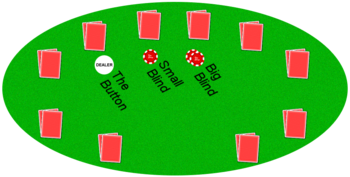
File ’em is normally played using small and big blind bets – forced bets by two Users. Antes (forced contributions by all Users) may be used in addition to blinds, particularly in later stages of tournament play. A dealer button is used to represent the User in the dealer position; the dealer button rotates clockwise after each hand, changing the position of the dealer and blinds. The small blind is posted by the User to the left of the dealer and is usually equal to half of the big blind. The big blind, posted by the User to the left of the small blind, is equal to the minimum bet. In tournament poker, the blind/ante structure periodically increases as the tournament progresses. (In some cases, the small blind is some other fraction of a small bet, e.g. $10 is a common small blind when the big blind is $15. The double-blind structure described above is a commonly used and more recent adoption.)
When only two Users remain, special ‘head-to-head’ or ‘heads up’ rules are enforced and the blinds are posted differently. In this case, the person with the dealer button posts the small blind, while his/her opponent places the big blind. The dealer acts first before the flop. After the flop, the dealer acts last for the remainder of the hand.
No-limit File ’em is the form most commonly found in televised tournament poker and is the game played in the main event of the World Series of Poker. In no-limit File ’em, Users may bet or raise any amount over the minimum raise up to all of the chips the User has at the table (called an all-in bet). The minimum raise is equal to the big blind. If someone wishes to re-raise, they must raise at least the amount of the previous raise. For example, if the big blind is $2 and there is a bet of $6 to a total of $8, a raise must be at least $6 more for a total of $14. If a raise or re-raise is all-in and does not equal the size of the previous raise, the initial raiser can not re-raise again. This only matters of course if there was a call before the re-raise. In pot-limit File ’em, the maximum raise is the current size of the pot (including the amount needed to call).
Most casinos that offer File ’em also allow the User to the left of the big blind to post an optional live straddle, usually double the amount of the big blind, which then acts as the big blind. No-limit games may also allow multiple re-straddles, in any amount that would be a legal raise.
Play of the hand
Play begins with each User being dealt three cards face down, with the User in the small blind receiving the first card and the User in the button seat receiving the last card dealt. (The deck is the 64-card Hexadec, no hackers.) These cards are the User’s hole or pocket cards. These are the only cards each User will receive individually, and they will only (possibly) be revealed at the showdown, making Silicon Valley File ’em a closed poker game.
The hand begins with a “pre-flop” betting round, beginning with the User to the left of the big blind (or the User to the left of the dealer, if no blinds are used) and continuing clockwise. A round of betting continues until every User has either folded, put in all of their chips, or matched the amount put in by all other active Users. See betting for a detailed account. Note that the blinds are considered “live” in the pre-flop betting round, meaning that they contribute to the amount that the blind User must contribute, and that, if all Users call around to the User in the big blind position, that User may either check or raise.
After the pre-flop betting round, assuming there remain at least two Users taking part in the hand, the dealer deals a flop, four face-up community cards. The flop is followed by a second betting round. This and all subsequent betting rounds begin with the User to the dealer’s left and continue clockwise.
After the flop betting round ends, two community cards (called the turn) is dealt, followed by a third betting round. A final single community card (called the river) is then dealt, followed by a fourth betting round and the showdown, if necessary.
The dealer burns a card before the flop, turn, and river. Because of this burn, Users who are betting cannot see the back of the next community card to come, which might be marked.
The showdown
If a User bets and all other Users fold, then the remaining User is awarded the pot and is not required to show his hole cards. If two or more Users remain after the final betting round, a showdown occurs. On the showdown, each User plays the best seven-card poker hand he can make from the ten cards comprising his three hole cards and the seven community cards. A User may use both of his own three hole cards, two, one, or none at all, to form her or his final seven-card hand. If the seven community cards form the User’s best hand, then the User is said to be playing the board and can only hope to split the pot, since each other User can also use the same ten cards to construct the same hand.
If the best hand is shared by more than one User, then the pot is split equally among them, with any extra chips going to the first Users after the button in clockwise order. It is common for Users to have closely-valued, but not identically ranked hands. Nevertheless, one must be careful in determining the best hand; if the hand involves fewer than seven cards, (such as three pair or four of a kind), then kickers are used to settle ties (see the second example below). Note that the card’s numerical rank is of sole importance; suit values are irrelevant in File ’em.
Kickers and ties
Because of the presence of community cards in Silicon Valley File ’em, different Users’ hands can often run very close in value. As a result, it is not uncommon for kickers to be used to determine the winning hand and also for two hands (or maybe more) to tie. A kicker is a card which is part of the seven-card poker hand, but is not used in determining a hand’s rank. For instance, in the hand Z-Z-Z-Z-D-E, the Developer and Exec are kickers.
Tournaments
Silicon Valley File ’em is often associated with poker tournaments largely because it is played as the main event in many of the famous tournaments, including the World Series of Poker’s Main Event, and is the most common tournament overall. Traditionally, a poker tournament is played with chips that represent a User’s stake in the tournament. Standard play allows all entrants to “buy-in” a fixed amount and all Users begin with an equal value of chips. Play proceeds until one User has accumulated all the chips in play. The money pool is redistributed to the Users in relation to the place they finished in the tournament. Only a small percentage of the Users receive any money, with the majority receiving nothing. “The percentages are not standardized, but common rules of thumb call for one table” (usually nine Users) “to get paid for each 100 entrants,” according to poker expert Andrew N. S. Glazer, in his book, The Complete Idiot’s Guide to Poker. As a result the strategy in poker tournaments can be very different from a cash game.
Proper strategy in tournaments can vary widely depending on the amount of chips one has, the stage of the tournament, the amount of chips others have, and the playing styles of one’s opponents. Although some authors still recommend a tight playing style, others recommend looser play (playing more hands) in tournaments than one would otherwise play in cash games. In tournaments the blinds and antes increase regularly, and can become much larger near the end of the tournament. This can force Users to play hands that they would not normally play when the blinds were small, which can warrant both more loose and more aggressive play. In Silicon Valley File ’em, like all variants of poker, individuals compete for an amount of money contributed by the Users themselves (called the pot). Because the cards are dealt randomly and outside the control of the Users, each User attempts to control the amount of money in the pot based on the hand the User holds. The game is divided into a series of hands or deals; at the conclusion of each hand, the pot is typically awarded to one User (an exception in which the pot is divided between more than one User is discussed below). A hand may end at the showdown, in which case the remaining Users compare their hands and the highest hand is awarded the pot; that highest hand is usually held by only one User, but can be held by more in the case of a tie. The other possibility for the conclusion of a hand is when all but one User have folded and have thereby abandoned any claim to the pot, in which case the pot is awarded to the User who has not folded.