
LET AMERICANS AND IRAQIS VOTE DIRECTLY TO END THE WAR
|
 If you wish, you may make a donation to the Iraq Initiatives Project in memory of Diane Thomas. Click on the secure PayPal button below. If you wish, you may make a donation to the Iraq Initiatives Project in memory of Diane Thomas. Click on the secure PayPal button below.
|

|
Please make a donation to the Iraqi Initiatives Project in the name of Diane Thomas, ¡Presente!
|
|
|
|
Please note: This Website is in the process of being updated.
Please read the material here and check back January 2 for the latest information on the Iraq
Initiatives Project’s strategy and plan of action.
|
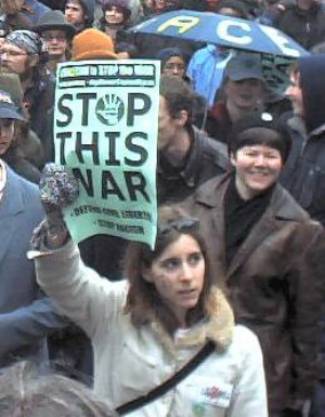 The Iraq Initiatives Project, which is sponsored
by the Ecumenical Peace Institute, is
an effort to encourage the idea of
Americans and Iraqis voting directly on ending the war. Six out of ten Americans believe that all U.S.
troops should come home from Iraq
within one year or less. Yet the war
has not been stopped. Electing a pro-peace majority in Congress and a
pro-peace president is necessary to
end the war but it is not sufficient. In
addition, voters in the United States
and in Iraq can have a direct say on
withdrawal, through ballot measures
in the United States calling for the
rapid withdrawal of all U.S. troops,
military bases and security
contractors (mercenaries) as well as
a national referendum in Iraq on the
U.S. occupation.
The Iraq Initiatives Project, which is sponsored
by the Ecumenical Peace Institute, is
an effort to encourage the idea of
Americans and Iraqis voting directly on ending the war. Six out of ten Americans believe that all U.S.
troops should come home from Iraq
within one year or less. Yet the war
has not been stopped. Electing a pro-peace majority in Congress and a
pro-peace president is necessary to
end the war but it is not sufficient. In
addition, voters in the United States
and in Iraq can have a direct say on
withdrawal, through ballot measures
in the United States calling for the
rapid withdrawal of all U.S. troops,
military bases and security
contractors (mercenaries) as well as
a national referendum in Iraq on the
U.S. occupation.
|
How many more must die in a war based on lies?
|
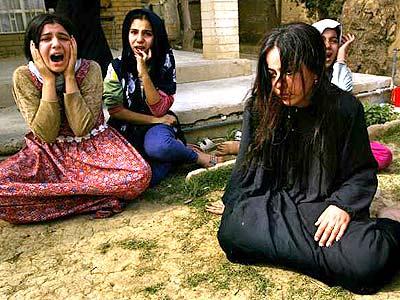
An Iraqi family mourns the deaths of three of their relatives, killed at a Baghdad checkpoint by U.S. soldiers.
|
|
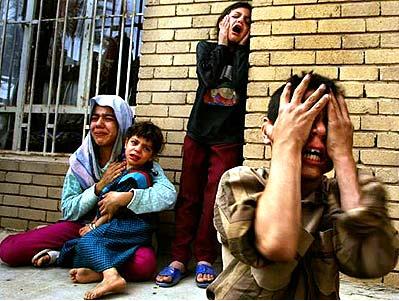
Over one million Iraqis have been killed since the U.S. invasion in 2003, with millions more wounded and forced from their homes and their country as refugees. We hear a lot about a decline in violence, but Iraq still has the highest violent death rate of any country in the world.
|
|

|
|
|
|
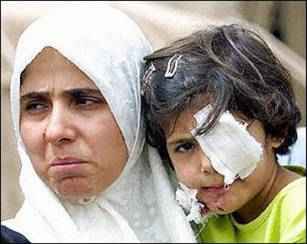
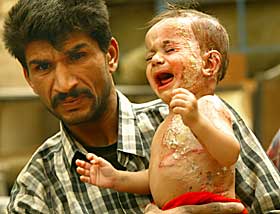
Over half of Iraqis are children. They have suffered disproportionately from the U.S. invasion.
|
|
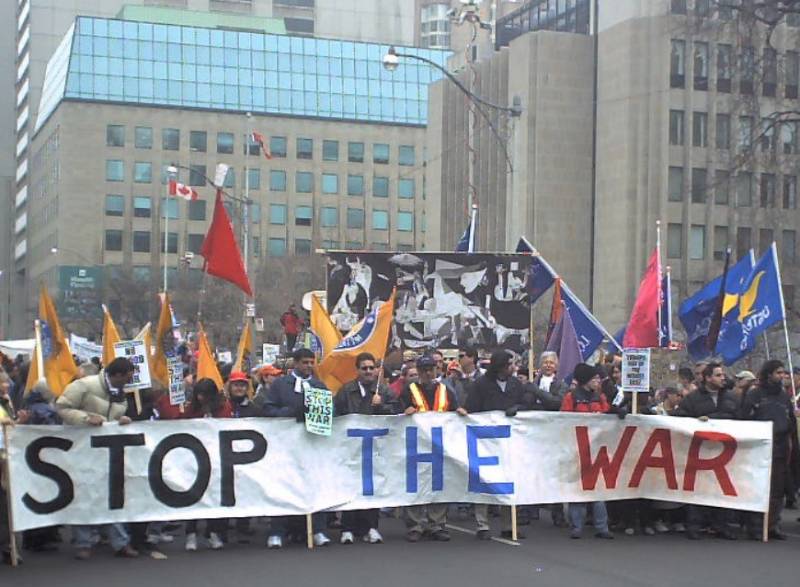
The media, and many politicians, tell us that the war is coming to an
end, the troops will slowly come home, and we should turn our
attention to the economic crisis. It is an outrage that another $200
billion will be spent on the war this year, money that is desperately
needed here at home. For our own sake, and for the people of Iraq, we
need to create the most effective strategy to end the war as quickly
as possible.
|
|
We support the Iraqi people in their
demands for a democratic solution to
the war and the U.S. occupation. With at least two thirds of Iraqis wanting all U.S. troops withdrawn
within a year or less, Iraqis will vote
to end the occupation. A U.S.
withdrawal from Iraq in response to
such a democratic vote will be a
major step toward peace and
reconciliation in Iraq. By providing
a democratic alternative to violence,
it will greatly reduce support for
terrorist groups and the threat of
terrorism against the United States.
If widespread anti-war ballot
measures are approved in the United
States, and the Iraqi people support
withdrawal in a national referendum
there, this will be the first time that
the people of an occupied country
and the people of the occupying
power will have voted together to
end a war.
To contact the Iraq Initiatives Project directly, email us at
initiatepeace@yahoo.com
The Iraq Initiatives Project is fiscally sponsored by the
Ecumenical Peace Institute. Donations to the Project are tax
deductible if made payable to the Ecumenical Peace Institute
and earmarked for the Iraq Initiatives Project. Ecumenical
Peace Institute/Clergy & Laity Concerned, P.O. Box 9334,
Berkeley, CA 94709.
Long-time peace activist Tom
Hayden has said of the Iraq
Initiatives Project strategy:
“The thinking is really brilliant. The value of initiatives here is to
educate and engage more Americans in the peace movement's
agenda and to build a greater mandate for withdrawal. The value
of the referendum in Iraq is much greater. If it passed (as it
would), it would undermine the occupation.”
The Iraq Initiative Project’s Strategy:
HOW CAN WE TAKE ADVANTAGE OF NEW
OPPORTUNITIES TO BUILD A MOVEMENT THAT CAN
FINALLY BRING AN END TO THE IRAQ WAR?
Barack Obama’s victory gives us a chance to struggle successfully for many
important goals in ways that have not been possible for years, even decades.
The Obama campaign was, in long-time activist Tom Hayden’s words, “the
largest mass movement in this country since the 1960s.” Yet Obama plans
to withdraw only half the troops from Iraq within 16 months. When will
the rest of the troops be withdrawn? It is likely that the Democrats will
sideline the Iraq War as an issue, focus overwhelmingly on the economic
crisis, and hope that we consider the problem solved with a withdrawal plan
that could take years.
We can again make the war a major issue. And new developments give
us the best chance ever to end the war quickly and decisively.
The American people will not tolerate another $200 billion spent on the
war next year when that money is desperately needed here at home. And
many are prepared to go beyond that, calling for major cuts to the military
budget and for a peaceful solution to the war in Afghanistan. Next year
many of the tens of thousands of new activists in the Obama campaign
can be mobilized against the war. In Iraq, major political parties and
religious leaders recently won their demand for a national referendum
there on the agreement between the U.S. and the Iraqi government to
extend the occupation for another three years.
And around the world, most people view the global economic crisis as at
best a product of gross negligence on the part of U.S. corporate elites and
the U.S. government, and at worst as a massive act of economic aggression. Over a thousand non-governmental organizations recently called for a
democratic solution (one country, one vote in the UN General
Assembly) to the world economic crisis, and for a democratic
restructuring of the global economic system.
In order for the peace movement to win, we need to greatly expand the
tactics and strategies that have won us important victories so far. We
need to have more and larger demonstrations, more counter-recruitment,
more effective education campaigns and lobbying, provide greater support
to G.I. resistance and to the Iraq veterans movement, work more in coalition
with groups organizing people against the economic crisis, among many
other actions.
But we need to recognize that the present moment gives us opportunities to
do much more. We can mobilize our own power and not depend on
others (like Congress) to act for us, and we must in the process create an end
game that can and will quickly end the war and the U.S. occupation of
Iraq.
We can accomplish this if we build on three high points of the anti-war
struggle thus far.
First, the international movement in the months before the war that
culminated on February 15, 2003 in the largest international peace
demonstrations in the history of the world, and prevented the United
Nations from endorsing the U.S. war of aggression against Iraq. World
public rejection of the war, forged at that time, has never changed.
Second, the victory of Barack Obama, and more importantly, the
grassroots movement that his campaign built. (And we must keep in mind
that much of Obama’s political success is due to the anti-war movement.)
Third, the recent success achieved by Iraqi political and religious
leaders in calling for a national referendum against the U.S. occupation.
This call for a referendum, this threat of popular democracy, is what forced
the Iraqi government to support some deadline for U.S. troop withdrawal,
however inadequate it might be. This success is the product of years of
democratic struggle by the Iraqi people, and of the growing influence of the
anti-war movement here.
DIRECT DEMOCRACY TO END THE WAR
How can we build on these victories?
We can create an end game in which the struggle for peace builds from
greatly expanded grassroots organizing and culminates in a direct
democratic repudiation of the Iraq War by millions who have suffered
from the effects of the war.
This strategy can enhance other important strategies of the peace
movement.
This struggle can result in the following three mutually reinforcing
democratic votes to end the war.
1. Initiatives against the war in as many states as possible in the
2010 elections. Our analysis shows that more than thirty states could
hold such initiatives, covering more than half the population. This
would in effect be the largest national “referendum” for peace in the
history of this country, far larger than the 9 states in 1982 which
passed the nuclear weapons freeze initiatives to halt the nuclear arms
race. We will tell the Obama administration before they take office in
January, that if Congress will not end the war in 2009, we will end it
in 2010. And we will add demands to these initiatives for cuts in the
military budget and for peaceful solutions to other U.S. wars.
November 2010 is a long ways away, but the necessary
announcement of this campaign in the summer of 2009 would make
Republicans and conservative Democrats afraid for their seats in the
2010 election. That alone would help end the war sooner. Most
importantly, for the tens of thousands of people who were active
in the Obama campaign, such a national initiatives campaign
would inspire them to once again contribute their skills,
enthusiasm, and will to win to another major progressive victory.
And the electoral methods used will be identical to those that they
had success employing in getting Obama elected. We will not be
asking these skilled activists to commit themselves to a strategy they
are not familiar with, one centered on demonstrations for example.
2. An internationally-supervised referendum in Iraq on the U.S.
occupation. This is the kind of referendum, run by the United
Nations, which ended the Indonesian occupation of East Timor in
1999. [See the comment below by Phyliss Bennis] Last May major
religious leaders and political parties in Iraq called for a national
referendum on the Status of Forces Agreement for continued U.S.
occupation being negotiated by the Bush administration and the
Maliki government. When the Iraqi Parliament recently approved
this Status for Forces Agreement, and legitimated another three years
of U.S. occupation, they also agreed to put it to a national referendum
next June. Yet even if the Agreement is voted down, U.S. troops
could still occupy Iraq for years. If the mere threat of popular
democracy can win that victory of a limited national referendum,
imagine the effects of an international campaign to support the
democratic rights of the Iraqi people to end the U.S. occupation.
Imagine further the effects of an internationally supervised
referendum (one that will have the support of the world’s people) in
which the Iraqi people actually vote for the U.S. to leave.
3. A majority vote in the UN General Assembly (and later the
Security Council) calling on the U.S. to leave Iraq, and
mandating that the UN push for and run a national referendum
in Iraq on the U.S. occupation. No occupying superpower will
quickly agree to allow its troops to be voted out by a popular vote (it
would set a terrible precedent, from their point of view, for any
future occupations, and for others that currently exist.) However,
through an international peace movement like the one that existed in
early 2003, in which over ten million people demonstrated in scores
of countries, we can effectively support the Iraqi people in their
demand for a democratic end to the occupation. The U.S.
government and corporate elites can be convinced that such a
referendum is preferable to their further delegitimization in the eyes
of the world. The U.S., after all, will need the cooperation of other
countries to weather the global economic collapse. Hundreds of
international organizations are calling for the UN General Assembly
to restructure the world economic system on a just and democratic
basis. It will in fact be much easier to gain the support of the
majority of countries in the world for a democratic end to the U.S.
war in Iraq, than to changing the global economic order. And such an
international victory for peace will inspire the poor countries of the
world to see that victory is possible against the U.S. and other rich
countries to create a more just economic order.
If the people of the U.S. and Iraq both vote to end the U.S. occupation, this
will be the first time that the people of an occupied country and the
people of the occupying power will have voted together for peace. This
will decisively undermine even elite support for the war. Most importantly,
if the U.S. actually completely leaves Iraq after these votes, it will greatly
reduce political support for, and recruitment to, terrorist organizations like
Al Qaeda. If one can end foreign occupations by democratic means, this
will undermine the appeal of a strategy of suicide bombings.
End the War in Iraq by Using ALL the Democratic Means Available
These direct democratic votes can play a major role in ending the Iraq War.
However, they will only happen through grassroots democratic organizing. A few examples.
1. Link the war to the economic crisis and budget cuts in state
services. One way to do this is to organize large local hearings
and town meetings next spring on the costs of the war to local
communities, first at the city and county level and building from
there to the state and national level. These costs include not only
the $3 trillion wasted on the war, but the human cost in American
and Iraqi lives lost, the foreclosing of options to solve problems
like global warming, the erosion of democracy, the increased
threats to the safety of the American people, and the other terrible
costs to the Iraqi people. Imagine thousands of people in a large
auditorium, with scores of people giving emotional testimony
about the effects of the war, with politicians listening - not
speaking - and then conveying the results, and people’s demands,
upwards to Congress. Most importantly, the coalitions formed
and the results of these actions will be an important basis for
the later national initiatives campaigns to end the war,
peacefully resolve other U.S. wars and cut the military budget
in order to fund human needs.
2. In universities, through democratic means (mass petitions,
student government elections, votes in the faculty senate, and
demonstrations) students and professors can demand that their
board of trustees call for an end to the war, and the transfer of war
funding to education, AND for a university wide convocation on
these issues, in which classes would be cancelled for a day to
consider these threats to students’ futures. Many of the most
dedicated Obama volunteers were college students.
3. In churches, unions and other civic institutions, we can utilize
the democratic governance available to demand an end to the war
– as many already have – and for a democratic solution to the
economic crisis. Many churches are part of international bodies in
their own denominations and as part of the World Council of
Churches. They could play a key role in further internationalizing
these efforts for peace.
These are only some ideas on how we can mobilize more effectively to end
the war. We invite your ideas.
David Raymond
Iraqi Initiatives Project
December 7, 2008
The following comment by Phyliss Bennis is still relevant to what needs
to be done to end the Iraq War.
Iraq's Elections [and a comparison to the UN-run referendum
in East Timor]
Phyllis Bennis
Institute for Policy Studies, 20 December 2004
As currently planned, the January 30th [2005] elections in Iraq are designed to
provide a veneer of credibility and legitimacy to the continuation of US control of
Iraq, through election of a US-friendly government that will welcome the US
military bases in Iraq, and through the drafting of a US-oriented constitution.
The United Nations has claimed that the precedent for "legitimate" elections held
under military occupation is the 1999 UN-run election in East Timor. But there
are significant differences. Most importantly, UN resolutions had, since 1976,
officially deemed the Indonesian occupation illegal and called on Indonesia to
withdraw. The 1999 vote was not to select a puppet "government" to administer
East Timor under continuing Indonesian occupation but was a direct referendum
on whether or not to end the occupation - a choice never offered to Iraqis.
Additionally, the Indonesian military was pressured sufficiently so there was little
military violence during the referendum itself. (The Indonesian military's razing of
much of Dili came after the election, not before or during.) And the balloting was
run directly by the United Nations, with thousands of UN election workers and a
wide array of international monitors.
One alternative would be to arrange the kind of referendum the UN ran in East
Timor, in which Iraqis would vote on whether or not to end the occupation and
for the foreign troops to be withdrawn. A possible three-choice ballot, for
instance, might include the options of voting to maintain foreign troops as they
are today; voting to set a date certain for the future withdrawal of foreign troops;
or voting for the immediate withdrawal of foreign troops. No consideration was
ever given to providing Iraqis with this kind of referendum, and there have been
no serious recent efforts to find out the opinion of the Iraqi population regarding
the maintaining of the US occupation.
Iraq Initiatives Project. Ecumenical Peace Institute/Clergy & Laity Concerned, P.O. Box 9334, Berkeley, CA 94709.
The thinking is really brilliant. The value of initiatives here is to educate and engage more Americans in the peace movement's agenda and to build a greater mandate for withdrawal. The value of the referendum in Iraq is much greater. If it passed (as it would), it would undermine the occupation.
—Tom Hayden


