Mother Agnes-Mariam of the Cross
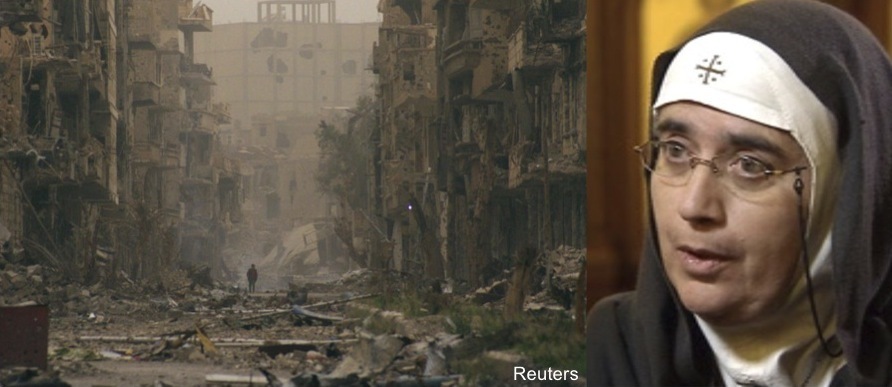
Mother Agnes-Mariam of the Cross is Mother Superior at the Monastery and Convent of St. James the Mutilated in Qara, Syria. Gunmen attacked her vehicle in May, 2013. Much of the population in the towns around the monastery have been made refugees.
But Mother Agnes tells a story that is very different from what we get in the Western press. She has spoken in Ireland and Australia, and organized an international delegation led by Nobel Peace Laureate Mairead Maguire to come to Syria. And she is one of the main organizers of Mussalaha (“Reconciliation”), a popular movement in Syria that mediates disputes and organizes ceasefires between opposing forces.
Mother Agnes is touring the U.S. and Canada in November and December 2013 to inform people about the reality in Syria and the need to stop foreign support and financing of terrorism. Her message is non-sectarian, promoting the values of Peace, Love and Reconciliation.
CURRENTLY SCHEDULED BAY AREA PUBLIC EVENTS
(see website below for latest schedule)
Sunday, Nov 3 at 5:30 PM, St. Thomas More Church, 1300 Junipero Serra Blvd. at Brotherhood and Thomas More Ways, San Francisco
Monday, Nov 4, 7:00 PM, Rebuilding Alliance, 178 South Boulevard, San Mateo CA 94402 (near Hwy 92 and El Camino)
Tuesday, Nov 5 at 4:00 PM, Creekside Room, 1010 Stanley Dollar Drive, Walnut Creek (Rossmoor)
Wednesday, Nov 6, 7:00 PM, Our Lady of Grace Church, Stack Hall, 3433 Somerset, Castro Valley
Thursday, Nov 7 at 7:00 PM, First Christian Church/Oakland Peace Center, 111 Fairmount Ave./259 29th Street (two blocks from Broadway and 29th), Oakland
Syria Solidarity Movement: (510) 232-2500
solidarity@syriasolidaritymovement.org • www.syriasolidaritymovement.org
Mother Miriam–Agnes FAQs
Who is Mother Agnes-Mariam of the Cross?
Mother Agnes-Mariam of the Cross is spokesperson for the Catholic Media Centre of the Diocese of Homs, Hama and Yabroud in Syria. She is also one of the main representatives of the Mussalaha Reconciliation Interfaith Initiative, which has the support of all Syria’s religious communities. She has been a fearless and indefatigable proponent for Syria’s persecuted.
Mother Agnes-Mariam, who was born in a Palestinian refugee camp in Southern Lebanon in December, 1951, joined the contemplative Carmelite order in 1971, where she remained until 1992 when she founded a new religious order within the Greek-Catholic Melkite monastic tradition. She drew on French, Syriac and Hebrew monastic traditions to develop her new order which specialised in the study of iconography and other facets of the region’s rich religious traditions. These efforts culminated in the restoration of the Monastery of St. James the Mutilated near Qara in the Diocese of Homs, Syria, which is now surrounded by the rebels and, like Mother Agnes-Mariam herself, finds itself in the front line of Syria’s civil war.
Is Mother Agnes-Mariam of the Cross pro-Assad?
Mother Agnes-Mariam is not pro-Assad. She favors the laying down of arms by all combatants, including the Assad regime. She believes that Syrians should be free to choose their own government without pressure from either outsiders or insiders, including the Assad regime. Like all Syria’s religious leaders, Mother Agnes-Mariam is a fearless proponent of peace through reconciliation. As a result, she and they are targets of those who oppose peace.
Does Mother Agnes-Mariam deny that the August 21st gas attacks took place?
No, she did not deny the attacks. However, she questions many of the videos that purported to show evidence of the attacks. She drew the attention of the United Nations to inconsistencies and anomalies in those videos. Because those inconsistencies and anomalies have still not been satisfactorily resolved, her criticisms still hold.
What is Mussalaha?
Mussalaha, which translates as Reconciliation, is a community-based non-violent popular Initiative stemming from within Syrian civil society. Founded at the community level, it includes members of all Syria’s ethnic and religious communities who are tired of the war. It stands as a demonstration of hope that a third way option to armed conflict remains possible and provides an alternative to military intervention from abroad. Mussalaha fills a void created by the noise of weapons: it does not side with any of the warring parties. Rather it embraces all. The movement says No to the continued loss of life which is bleeding the nation white. The Initiative says No to civil war and rejects all forms of sectarian violence and denominational strife.
Its founding session was held on 25 January 2012 in the Sahara complex on the Syrian coast. Thanks to the prominent religious and national figures present there, this event has had a historic impact since it showed that a third way remains possible over and beyond the regime-opposition conflict: the way of civil society. These meetings have already had a very positive outcome, resulting in a public commitment to building a reconciled and peaceful Syria in the name of mutual respect, through the endorsement of joint declarations, and solemn commitments to reconciliation between groups, families and between the main protagonists in the current conflict. Despite the continuing conflict in Syria, the Initiative continues to gain traction. It is imperative at this critical time that the M! ussalaha reconciliation Initiative be recognised, nurtured and sup ported by all who believe in peace through dialogue.
WHAT ARE MUSSASAHA’S TEN POINTS TOWARDS RECONCILIATION AND PEACE?
- Support conflict resolution through negotiation and implementation of a democratic process.
- Stop the flow of weapons to Syria.
- Stigmatize the war methods that are against the Geneva Convention.
- Restrain interference from abroad in the Syrian conflict.
- Furnish honest information about the Syrian conflict.
- Support new political parties that are proliferating and giving new shape to the Syrian political landscape.
- Stop the sanctions, which are harming only the civilian population.
- Fairly distribute humanitarian aid.
- Appeal for impartiality among the diverse NGOs working in the Syrian conflict.
- Support a new state that will guarantee equality of citizenship and religious freedom to any religious and ethnic group.
